
CS 477 Lecture Notes
Week Thirteen, Thursday: Early Project Demonstrations
Homework Assignment
Worth 10 points, due Thursday, week 14, 1999, in class:
Write a one-page (exactly) essay on your term project team experience. What was good
about it? What was bad about it? What could be done next year to improve things to make
the experience more relevant and valuable? Use this format: 12 point times font,
one-and-a-half spaced lines. Use one half line above and
below justified non-indented paragraphs (block style). One inch (+/- 1/8 inch) margins all around.
One point off for each error in formatting.
This will be the last homework assignment for the semester.
Demonstration Agenda
This time is available for any team that wants to get its demonstration
out of the way a week early.
Java: A Case Study in Software Engineering
This lecture is based on the Epilogue (p. 483) in Software Engineering with
Java.
Java was created by James Gosling to overcome the reliability and security
shortcomings of C++. The portability, security, and robustness of Java make it a case
study in software engineering.
Java and Modularity
Java is a pure object-oriented language (does not support functions or procedures)
so its modularity is in the form of classes. Java allows classes to be grouped
into packages:
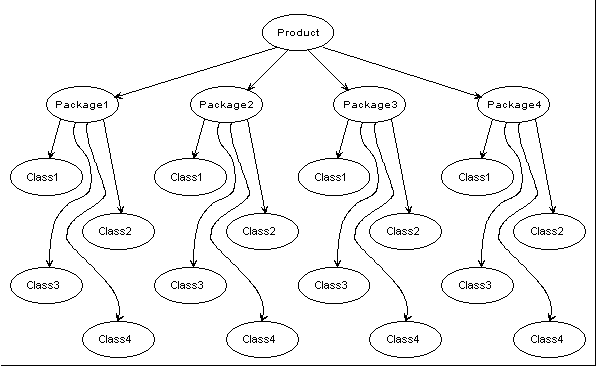
A Java product can be divided into packages
assigned to individual programmers.
Java packages provide another layer of abstraction with its own level of
visibility (scope).
Multiple Inheritance
Multiple inheritance is occasionally necessary, but it can make software extremely
complicated and difficult to understand. Java does not support multiple inheritance,
but its "interfaces" provide the major benefit of multiple inheritance without the
drawbacks.
Java and Structured Programming
Java does not suport goto, but this issue is a bit of a red herring. I have never
seen goto used in any C or C++ program in practice. It's a bit like saying that
a dog is superior to a human being because a dog is incapable of being disloyal.
Java and Portability
Portability is an important issue. C and C++ code is just as portable (theoretically)
as Java code because all you have to do is port a compiler to the new machine. In
practice however, porting is not so easy. X-Window programs for example, are hard to
port to Wintel because of the vast differences in the Windows API and X-server.
Java programs have finally fulfilled the promise of portability which can be
demonstrated easily by running this
applet
in Wintel and Macintosh simultaneously.
The performance of Java programs is usually worse by a constant factor (5 to 10)
than a comparable program written in C or C++. However, if performance were the
most important criterion, we would all be coding in assembly language. For those
applications where performance is critical, Java code can be translated to C code with
the java2c program and compiled natively with an optimizing C compiler. A properly designed
optimizing compiler will unroll loops move functions inline without the
programmer having to worry about it.
Java does not support memory leaks like C and C++ do. The Microsoft Foundation Classes
(MFC) still have memory leaks five years after they were first reported.
Java and Security
Viruses (and other malevolent code) frequently use pointers to access restricted
address space. This is not possible in Java. As the world grows more connected,
computer security will also grow in importance. Applets implement additional
safeguards for security.
Java and Reliability
Java is a strongly typed language. C++ supports strong typing, but because it is
compatible with C, it does not enforce it. One of the most weakly typed languages
is Visual Basic, which can lead to some extremely sloppy coding habits.
Java has array bounds checking. A common source of bugs in C and C++ code is
referencing memory beyond the end of an array.
Java's absence of memory leaks also enhances its reliability.
Java and Object Orientation
As mentioned above, Java is a pure object oriented language. However, that doesn't
mean it can't be used in a structured paradigm way. Object oriented design requires
knowledge and discipline to achieve the advantages of the object oriented paradigm.
Java and Reusability
Java does not support templates. However, interfaces, and the ability to pass
the top Java class, Object, and cast it to the desired type, effectively implements
the template capability. Java.util.Vector is an example.
Java and Visibility
The access specifiers of Java are a little more convoluted than those of C++,
but C++ has the "friend" specifier that can make code more confusing. The
scope (visibility) levels of Java are summarized in the table below:
| Visibility Level |
Description |
Key Word |
| Public |
Access from anywhere in the product. |
public |
| Protected |
Package visibility (see below) plus: a subclass in a different package
can inherit attributes inherited from its superclass (but
cannot access attritutes of instances of the superclass). |
protected |
| Package |
Access from anywhere in the package in which it is defined. |
<null> |
| Private Protected |
Access from within an instance of the class in which it is
defined plus: access from within instances of subclasses. |
private protected |
| Private |
Access from within an instance of the class in which it is defined. |
private |
Note that package level visibility is the default if no attribute specifier is used.
These rules apply to both attributes and methods.
Java: Language of the Web
The various communications protocols (TCP/IP, HTTP, sockets, UDP, etc.) can be used
in many languages. The Berkeley Socket library, for example, is written in C.
The Java.net package provides convenient access to many Internet and Web protocols.
Java is enhanced as the "language of the Web" by its features such as reliability,
security, and portability. However, "Java is the language of the Internet because
it was well designed from the start, not because it was specifically designed for
Internet use. In other words, Java is indeed a case study in software engineering."
This page established April 8, 1998; last updated January 18, 2000.