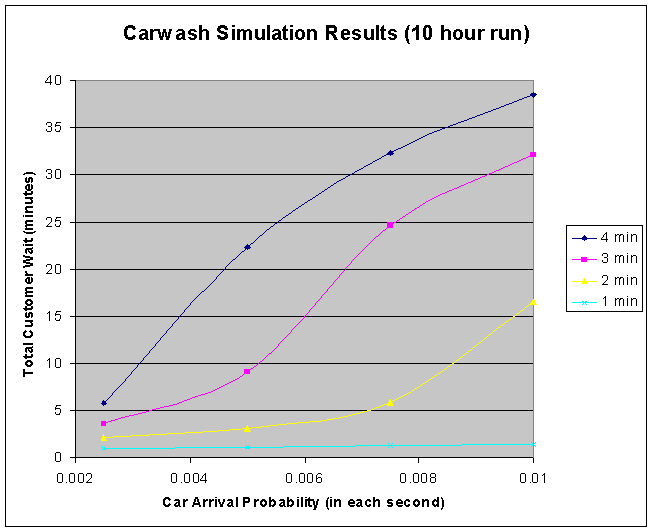
Carwash simulation results.

Cars in traffic wait in queues too. The first car at a red light waits at the intersection. The next car to arrive stops behind the first one, and so on.
If capacity always exceeded demand, queues wouldn't be necessary. Suppose there is a bank that has an unlimited number of tellers. There would never be a line formed in the bank because there would never be any waiting for a teller (this is an example of parallel processing). Resource scarcity is a fact of life, however, and computer systems and networks are no exception.
Operating systems use queues for many things. For example, the keys pressed and mouse operations go into buffers (queues) to await processing.
If a Web server receives more page delivery requests than it can serve at once they are queued and served in order of arrival. Similarly with other network servers like a print server or file server.
In the Networks Laboratory (Prof. Deborah Estrin) right here at USC network simulators are used for developing new network protocols. A network simulator uses queues extensively.
In designing a factory, manufacturing engineers use simulations to find out the optimal configuration and layout of a factory and to verify that the production rate will meet expectations. Factory simulations use buffers and machine simulators extensively in piplined processes (both parallel and single). Sometimes factory buffers are actually stacks and not queues, such as when a product is stacked on a pallet and removed in reverse order.
The MS text presents an example of a carwash simulation. There is only one car washing machine, so there is no parallelism and no pipeline. It's one of the simplest simulations conceivable, having only two objects, a queue and a washer. Nevertheless, it provides an interesting example if one should run the simulation with a variety of input parameters. Even the simplest simulations often provide results that are non-intuitive (therefore they are interesting).