
CS 101 Lecture Notes
Week Fourteen, Monday/Tuesday: Engineering Applications
Computer Aided Design
Computer aided design (CAD) is one of the most important computer applications ever developed.
CAD has revolutionized engineering design and productivity. With CAD, engineers can rapidly
optimize designs with virtual prototyping, and can re-use proven designs easily. With the invention
of constructive solid geometry (CSG) by USC's
Ari Requicha,
mechanical engineering, civil engineering, and architecture benefit from true 3D solid object
shaping and manipulation.
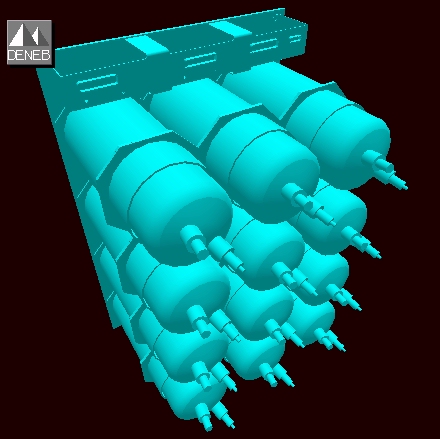
Solid model of the battery assembly of the
SBIRS spacecraft.
AutoCAD (from
AutoDesk)
was developed for the personal computer in the 1980s and is now the world's most popular CAD
program. It has modules for EE, ME, and Architecture.
Here's a
demo
of Mechanical Desktop.
Finite Element Analysis
Finite element analysis (FEA) is a technique where solid parts are modeled as collections of
discrete elements. This allows comprehensive stress, thermal, and dynamic analysis. The result
is more reliable designs with better design margins. Most modern CAD programs provide interfaces
for FEA.
Manufacturing Simulation
Before building a factory, engineers may want to simulate its operation
to verify their design.
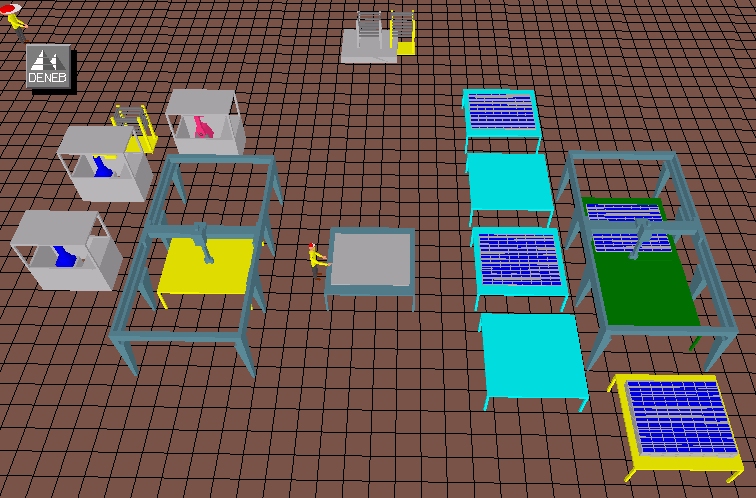
Solar array manufacturing facility simulation.
This
program example
is a very simple manufacturing
simulation. There are two machines in this factory. The first machine runs
three processes (assembly machine) and the second machine runs one process
(polishing machine). The factory is building widgets out of wickets and
gadgets.
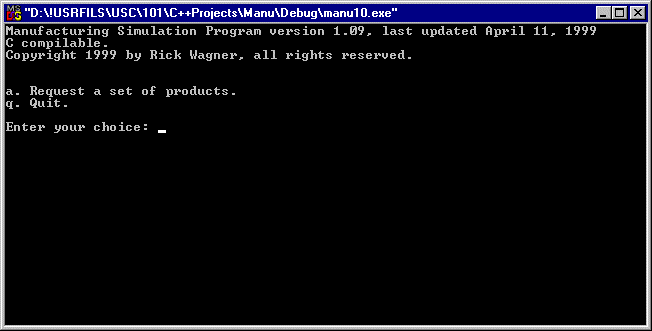
Program start-up screen.
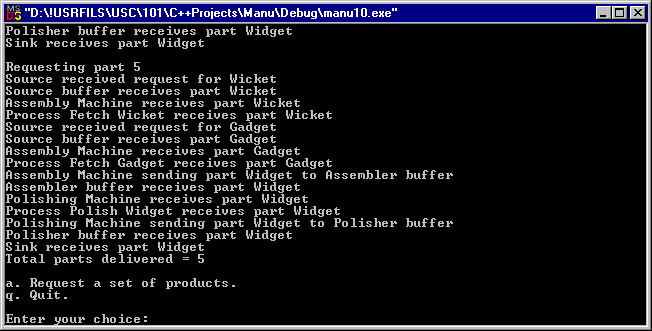
After five widgets have been built.
Manufacturing simulations can help engineers optimize a factory layout. For
example, if a bottleneck is discovered it can be alleviated by adding
machines in parallel.
This page established April 12, 1999; last updated April 14, 1999.